Le Marché des Imaginaires Numériques
October 28
October 29–30
October 31
Avignon & Arles
Aix-en-Provence
Marseille
To mark the opening of the Biennale des Imaginaires Numériques, the Marché des Imaginaires Numériques (MIN) invites professionals from the cultural and creative industries to analyze the impact of digital technologies on creative work. At the intersection of artistic, economic, and forward-looking perspectives, this international event examines the challenges and goals of these transformations in order to strengthen our capacity for action.
The 2026 Edition
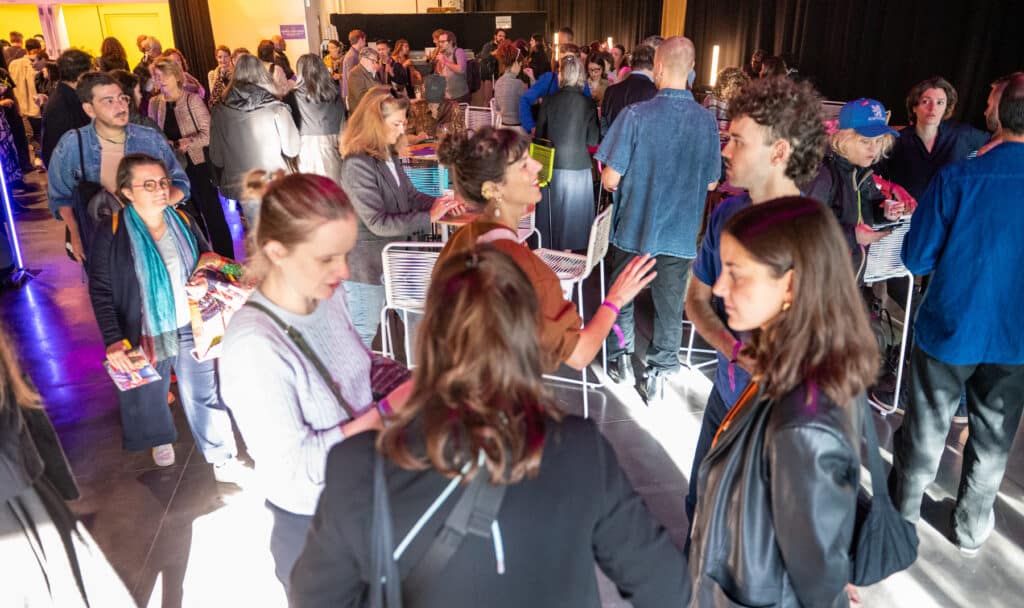
Following the 2024 edition, which was marked by rich exchanges and the participation of more than 40 nationalities, this second edition of the MIN aims to examine the role of digital technology in the transition(s) facing the creative and cultural industries. Digital technologies, now at the heart of these industries, are often seen as the key to the sectors’ growth—a suitable solution to support the shift from one model to another. But what transition are we talking about? What transformations does digital technology actually bring about when faced with economic or ecological constraints?
The guests will thus explore the topic, covering adaptation strategies, resistance movements, and, at times, even distancing oneself from digital technology. Through four thematic areas, we will reflect on the challenges and goals of these transformations in order to strengthen our capacity to take action, both individually and collectively.
The MIN is also a festive and welcoming networking venue designed to accelerate cooperation and business development. It also offers the opportunity to broaden your professional horizons from October 28 to November 1 by connecting with the ICC ecosystems in Arles, Avignon, and Marseille, in addition to the meetings and conferences in Aix-en-Provence.
Topic Beyond Transition
Digital technologies, now at the heart of the cultural and creative industries, are often seen as holding the key to the sectors’ growth—a suitable solution to facilitate the shift from one model to another. But ultimately, what transition(s) are we talking about? What changes does digital technology actually bring about?
From an economic perspective, the creative industries are questioning the viability of their business models and the financial support needed to navigate these changes. Many technological promises, however, come up against the world’s limited resources and serve as a reminder of the environmental challenges that are often sidelined by a succession of crises. Nevertheless, a digital shift is already well underway. It is most evident in creative practices—those of artists, entrepreneurs, and researchers. It can also be observed in the behaviors of audiences. Where and how is art created today? In what spaces does it unfold? What are these new cultural experiences? These perspectives are all the more exciting because they position art and culture as new worlds—not to be conquered, but to be imagined.
2 days of conferences
Aix-en-Provence
October 29 and 30 at 6MIC

Opening address by Tania de Montaigne
Author and chair of the CNC’s Immersive Media Committee
To kick off these two days, we have invited an author who has experienced the digital transition from the inside.
Tania de Montaigne explores the transition from one medium to another, from one world to another, drawing on the virtual reality adaptation of *Noire*. An author’s perspective on technological changes and those currently reshaping the world of culture.
By exploring the multiple meanings of the word “transition” to better envision our possible futures, the guests outline several paths: adaptation strategies, resistance movements, and sometimes even distancing ourselves from digital technology. Through a cross-disciplinary approach—combining talks, case studies, panel discussions, and networking activities—this professional event will revolve around four major themes:
• Transition and the economy: (re)thinking the sustainability of the CCI models, the challenges of European technological sovereignty, and the new algorithmic paradigm.
PANEL – A digital transition, yes! But where will the money come from?
At a time when local and national funding is becoming increasingly scarce, where can we find the resources to provide practical support for this transition? With Stéphane Segreto-Aguilar (Relais Culture Europe), Fabio Trotabas (Culturing Company) and Jean-Gabriel Minel (DGMIC). Moderated by Elsa Ferreira.
• Transition and Ecology: Exploring the sustainability challenges facing cultural infrastructure and the creative sector in the face of ecological crises.
PANEL – Goodbye, ecology… Is the environment still a concern? Decarbonisation, short supply chains: projects overshadowed by financial emergencies. What if the environment were, despite everything, still the guiding principle behind our activities? With Anne-Laure Belloc (Stereolux), Pauline Pezerat (Flying Secoya), Allison Moore (artist) and Guilhem Chabas (MCC – DGCA). Hosted by Elsa Ferreira.
• Transition and society: addressing ethical issues, creative freedom and mediation through new digital spaces.
TALK – Art against techno-fascism: Facebook, Amazon, Google, NATO – hacking interventions by an artist who also puts forward proposals for regulation. By Paolo Cirio.
• Artistic transition: analysing the evolution of emerging scenes, immersive art and the impact of technology on the creative process.
PANEL – Does the future of music lie in immersive experiences? VR concerts, spatialised sound installations, augmented operas: beyond the novelty factor, how are these technologies transforming the listening experience and a sense of presence? A round-table discussion co-organised with 6MIC, featuring Étienne Guiol (BK International), Maud Clavier (Zorba) and Rodrig de Sa (360Prod). Moderated by Elsa Ferreira.
Complete itinerary
Avignon, Arles, Aix-en-Provence & Marseille,
, October 28–31, 2026
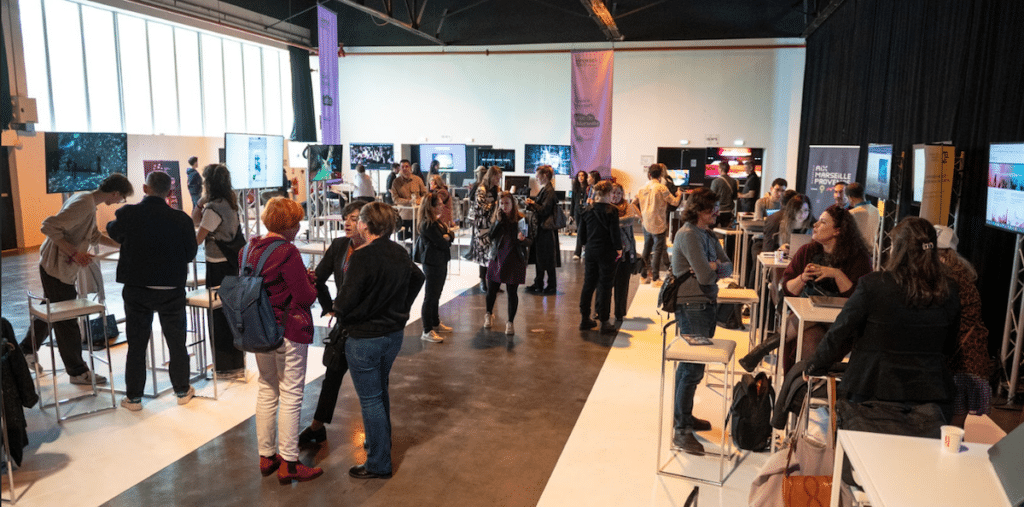
In addition to the two days of meetings and conferences in Aix-en-Provence, the initiative will expand to the regional level through an extended professional program from October 28 to 31, 2026. This tailor-made program will allow you to explore the creative ecosystems of the Région Sud and develop opportunities for co-productions and distribution channels between Arles and Marseille.

L’interprétariat du Marché des Imaginaires Numériques est sponsorisé par Converso