INVIVO FR
Rabbit Hole
Show presented by Scènes & Cinés at L’usine
Opening in Istres
Friday, November 6, and Saturday, November 7
- Show at 8:00 p.m.
Running time: 1 hour 15 minutes
Ages 12 and up
Scènes & Cinés – L’Usine
Istres - Augmented reality installation from 10 a.m. to 6 p.m.
Cour de l’ancien Musée archéologique,
Rue du Puits Neuf
Mentions
A programmation by Scènes & Cinés, in partnership with the Biennale of Digital Imaginary
A project by the CHRONIQUES CRÉATIONS Platform.
Production : INVIVO
Coproductions : Fonds de production Zéphyr – plateforme
jeunesse en Nouvelle-Aquitaine, Théâtre de l’Union – CDN du Limousin, Théâtre Ducourneau – scène conventionnée jeunesses d’Agen, Les Gémeaux – scène nationale de Sceaux, LUX – scène
nationale de Valence and CHRONIQUES, a regional centre for creative work in the digital environment – SUD Region – Provence-Alpes-Côte-d’Azur, as part of the Biennale des Imaginaires Numériques.
Soutiens : CNC, Fonds d’aide à la création immersive,
Programme Cultures connectées (Région Nouvelle Aquitaine et DRAC Nouvelle Aquitaine), Adami, Spédidam, Scène Nationale du Sud Aquitain.
INVIVO est conventionné DRAC Nouvelle Aquitaine, Département du Lot-et-Garonne, et soutenu par la Région Nouvelle Aquitaine et la Ville d’Agen.

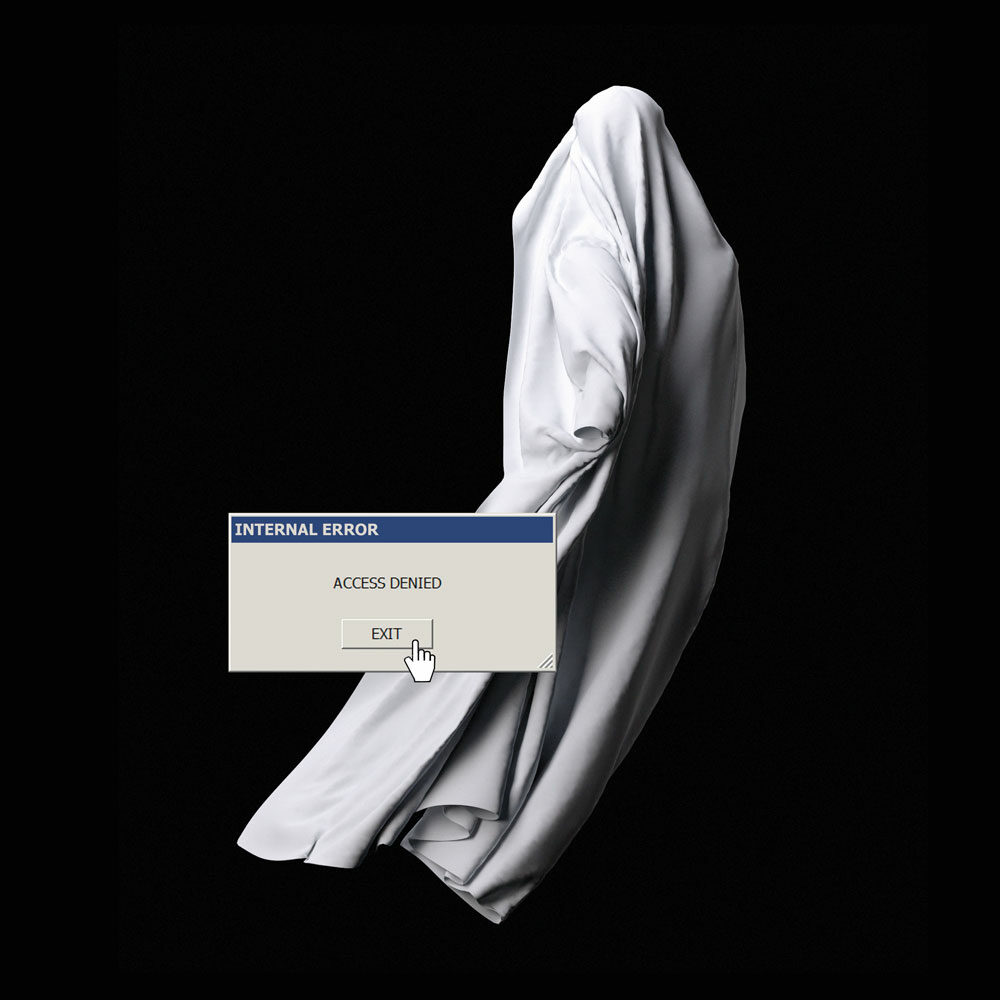
Rabbit Hole is a theatrical production for teenagers (and older) that explores our digital addictions through two formats: a play in which three characters from different generations cross paths around an abyssal fountain, until a teenage girl sparks a liberating revolt; and an augmented reality installation that plunges the viewer into an infinite fall, where scrolling and swiping become political acts.
Let’s imagine that, for the time it takes to read these few words, we shield ourselves from all other external distractions. Let’s imagine that the space of theatrical performance has become one of the last bastions where we can still come together, without any interface slipping into the gap. Let’s imagine that the need for screen-free sanctuaries—for “de-digitized” zones—becomes a societal necessity.
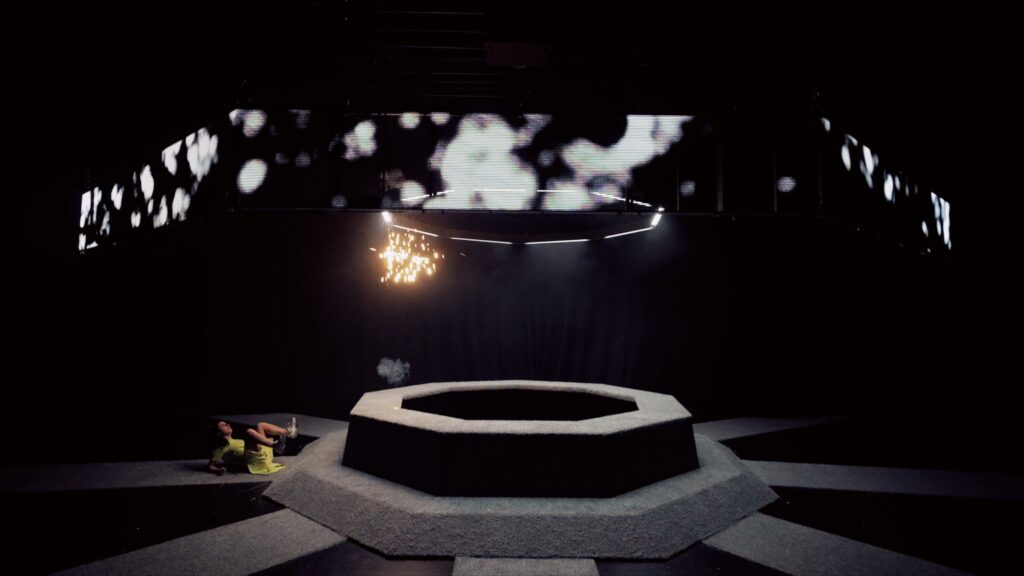
Rabbit Hole is set in this space between dreams and reality. It is a theatrical production aimed at a teenage audience—though not exclusively—and consists of two parts: a live, front-of-house performance and a digital experience in the form of an augmented reality installation.
The show Rabbit Hole offers a willing suspension of time and disbelief, a temporary setting aside of screens. In this space-time—a sort of blank zone conducive to boredom—we encounter three characters from three different generations. They live side by side, crossing paths at the edge of a strange fountain with an abyssal depth. All are in the grip of their technological addictions, but the youngest—a teenager—will become the catalyst for a liberating digital revolt, leading to the group’s rebirth.
The Rabbit Hole installation, meanwhile, offers an experience outside the theater near a fountain similar to the one featured in the set design. Through augmented reality, the audience will discover a virtual, endless fall into the fountain, where scrolling and swiping are the only possible actions. These gestures, which have become cognitive reflexes, will be examined in terms of their political and social dimensions, in a world reduced to a shadow of its former self.
In both formats—which function as interconnected portals between the inside and the outside—real, virtual, and dreamlike spaces will unfold before our eyes.
Cast
Julien Dubuc, concept and direction
Julien Dubuc and Lou Valentini, along with the creative writing team
Sumaya Al-Attia, Rémi Rauzier, and Émilie Waïche (acting); Lou Valentini (voice-over)
Elsa Belenguier, Set Design
Grégoire Durrande , Sound Design
Lucas Collet Lighting Design
Lucas Collet, Julien Dubuc, and Antoine Vanel: Video Production
David Udovtsch: Magic; Gwladys Duthil: Costumes
Antoine Vanel – Blindsp0t: Virtual Worlds and Augmented Reality
Pierre-Mickaël Faure: A Choreographic Perspective
Lise Déterne, L’Echelle Administration
Caroline de Saint Pastou, Development (Production and Distribution)
INVIVO
INVIVO was founded in 2011 as a collective. The team came together to explore the following question: How can the audience’s perception and sensations create a new form of storytelling?
With fifteen years of creative work, collaborations, cultural and artistic initiatives, and outreach under its belt, the team has successfully established itself as a leading force in the theater and digital arts sectors. Under the artistic direction of Julien Dubuc, INVIVO continues to develop, through each project, its distinctive creative voice and its commitment to exploring the audience’s role and perceptions.
Julien Dubuc and INVIVO are associate artists at the Théâtre Ducourneau, a state-subsidized youth theater in Agen, and members of the Théâtre de l’Union ensemble, the National Center for Dance (CDN) of the Limousin region. INVIVO is funded by the DRAC of Nouvelle-Aquitaine and the Lot-et-Garonne Department, and supported by the Nouvelle-Aquitaine Region and the City of Agen.