Hela Lamine TN
Still Life
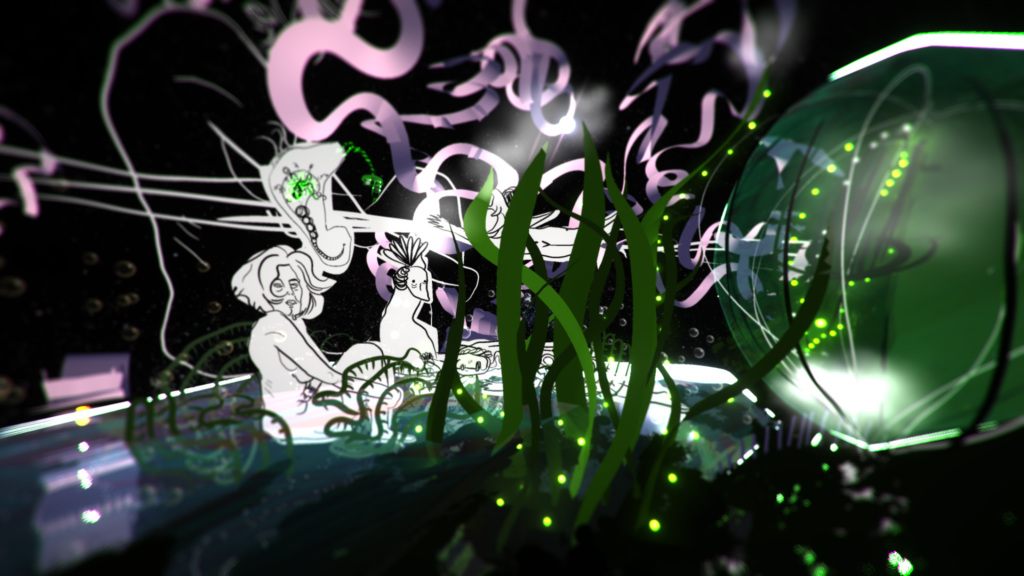
Live VR drawing performance with the audience, watercolors
Exhibition Tension Lines, Drawing, Virtual Reality, and Resistance
October 10–November 28
Wednesdays through Saturdays, 2:00 p.m.–6:00 p.m.
ARTEUM MAC
Châteauneuf-le-Rouge
Credits
Exhibition conceived and produced by ARTEUM MAC

A female character has developed what is known as severe ecological stress. Every aspect of her daily life—the way she consumes, gets around, and simply exists—has become a source of anxiety. The only solution she finds to keep living is to transform herself into a tree. She goes into the forest, walks for a long time, and lies down. She has no idea how it works. She closes her eyes and begins to breathe, listen, and feel the transformation taking place within her. Still Life explores this transformation—adaptation as the only means of survival. The experience is drawn line by line inside a virtual reality headset—not on a computer, but in physical space. On stage, in front of the audience, with a brush of light in her hand: her entire body is the one drawing.
Hela Lamine
Hela Lamine, born in Tunis in 1984, lives and works in Tunis. She is a graduate of the Tunis Institute of Fine Arts and the University of Paris I Panthéon-Sorbonne. Given her training as an engraver, drawing—which traditionally forms the very foundation of a print—plays a very important role in her work. Never taken for granted but constantly reexamined, Hela Lamine is interested in the technical and historical evolution of drawing, and above all questions the role it can play “in the age of technical reproducibility.” She thus explores the notion of “aura,” as well as that of the “sacred,” the confrontation between the “unique” and the “multiple,” the “original” and the “reproducible,” the “consumable,” the “consumed,” and “what remains”… leading to a form of linear excess that, over time, takes the form of superimposable layers similar to sedimentary strata. VR (virtual reality) drawing has played a very important role in her research over the past few months. She works primarily in series, all of which are based on portraits and/or human bodies that she discovers daily on the internet, as well as in books, magazines, and newspapers. She collects, archives, rearranges, draws, dissects, observes, repositions, and redraws them over and over again, in an almost obsessive manner; she stages and restages them in fictional narratives she describes as “open,” in reference to Umberto Eco’s concept of “open works.” The figure/body is often treated harshly in these works, oscillating between beauty and ugliness, between figuration and abstraction, between dream and nightmare… the human body is pushed ever closer to its own limits—and sometimes far beyond them. For her solo exhibition titled “The Unsecret Life of Samantha.C,” Hela Lamine decided to conduct a unique experiment lasting a year and a half, during which she secretly tracked the posts of a certain Samantha—chosen at random on Facebook—and worked with all the digital data to which she had legal access. What interested her most were the publicly visible photographs featuring Samantha, her friends, and her family. In 2015, Hela Lamine exhibited more than 100 graphic works, including paintings, drawings, and mixed media pieces, all exploring the “non-secret” life of Samantha.C. Since 2007, she has participated in numerous group exhibitions in Tunisia and abroad.