Khalil Epi FR
Tuqus – طقوس
Live audiovisual performance
Saturday, October 24, 2026
, at 8:30 p.m.
Friche la Belle de Mai
Grand Plateau
Marseille

The word ” Tuqus ” is the plural of ” Taqs” and means “ritual,” “ceremony,” or “sacred practice” in Arabic. This word derives from its homonym “Taqs,” which refers more specifically to the atmosphere, climate, or weather—that is, “the thing that envelops and alters the air and light.” This connection between the concepts of ritual and time in the Arabic language is highly significant. It leads us to a deep understanding of what a ritual is—that which envelops and transforms souls through gestures, rhythms, songs, the sacred, and repetition, in order to transcend the invisible. A ritual, or a taqs, is ultimately a cycle, a time of transition, a journey: from a neutral state to chaos, and from chaos to a new order.
An immersive film-concert by Khalil Hentati (EPI), *Tuqus* crosses the Mediterranean to film trance practices that are still alive today: Tunisia, Egypt, Morocco, Italy, and Greece. Gestures passed down through generations, rhythms repeated to the point of exhaustion, communities that open themselves together to the invisible—and emerge transformed.
On stage, these images interact with a live electronic musical performance and an immersive visual set design. Sounds recorded on location become the fabric of the soundscape; cinema becomes an instrument; the concert becomes a ritual.
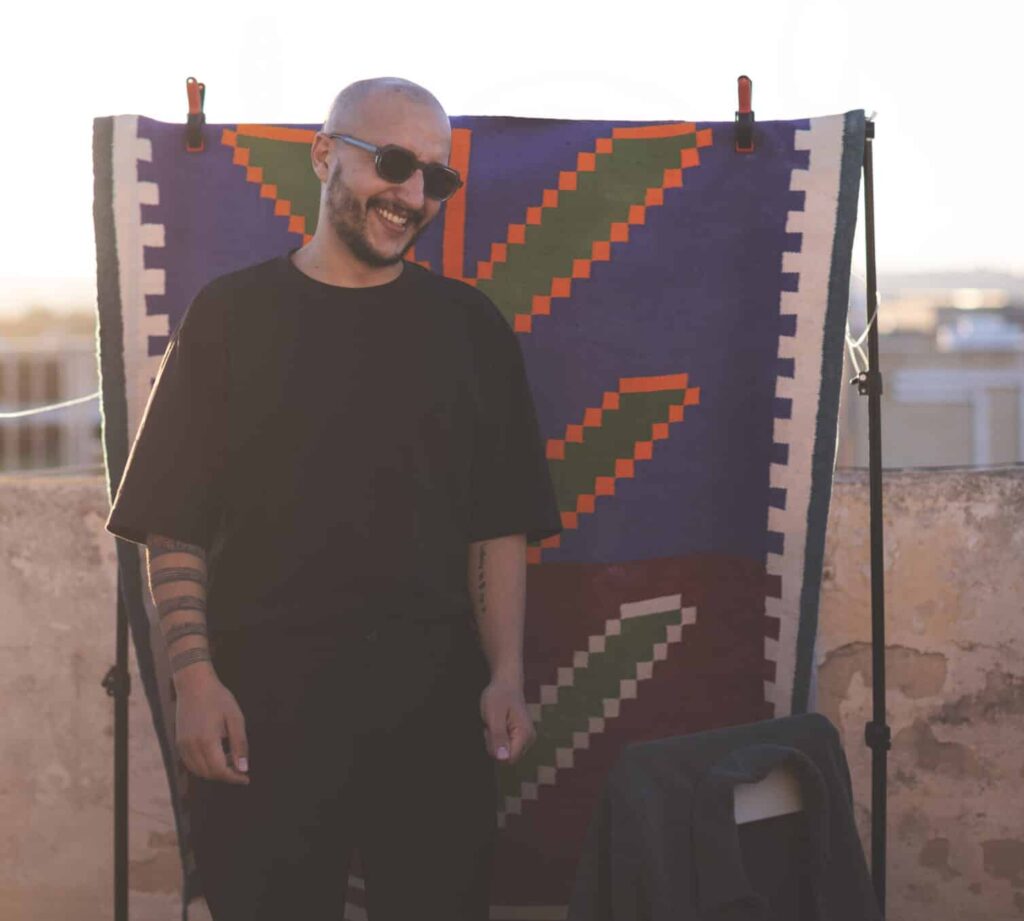
Khalil Epi
Composer, multi-instrumentalist, and video artist Khalil Hentati (EPI) has established himself as a central figure in the contemporary electronic reinterpretation of traditional and popular music. His soundscape moves freely between electronic, improvised, club, and classical music, bridging the gap between tradition and modernity with rare coherence and emotion.
*Aïchoucha*, his immersive production blending live music and a documentary film that he directed himself, has been a resounding critical and popular success—hailed by artists and major institutions for its unique approach to North African sound memory. His duo, Aïta Mon Amour, with Moroccan singer Widad Mjama, has since toured extensively, bringing their vision of contemporary Arabic popular music to stages across Europe and beyond. He is also a member of Frigya alongside percussionist Imed Alibi.
Over the years, he has collaborated with a wide range of artists, dancers, and musicians — N3rdistan, Seydou Boro, Masrah el Khachaba, Arabstazy — through visual art, contemporary dance, animation, orchestration, and lyrical arrangement. He co-directs the Franco-Tunisian record label Shouka and is a co-founder of Mottamar, the Arab Congress of Electronic and Innovative Music.