Said Afifi MA
Lithosphere
Painting
Exhibition “ Sensitive Cartography and Reconstructed Memories ”
From October 23 to December 13, 2026
From Wednesday to Sunday, 2pm to 7pm
La Belle de Mai Brownfield Site
Panorama
Marseille
Credits
Produced by: Said Afifi

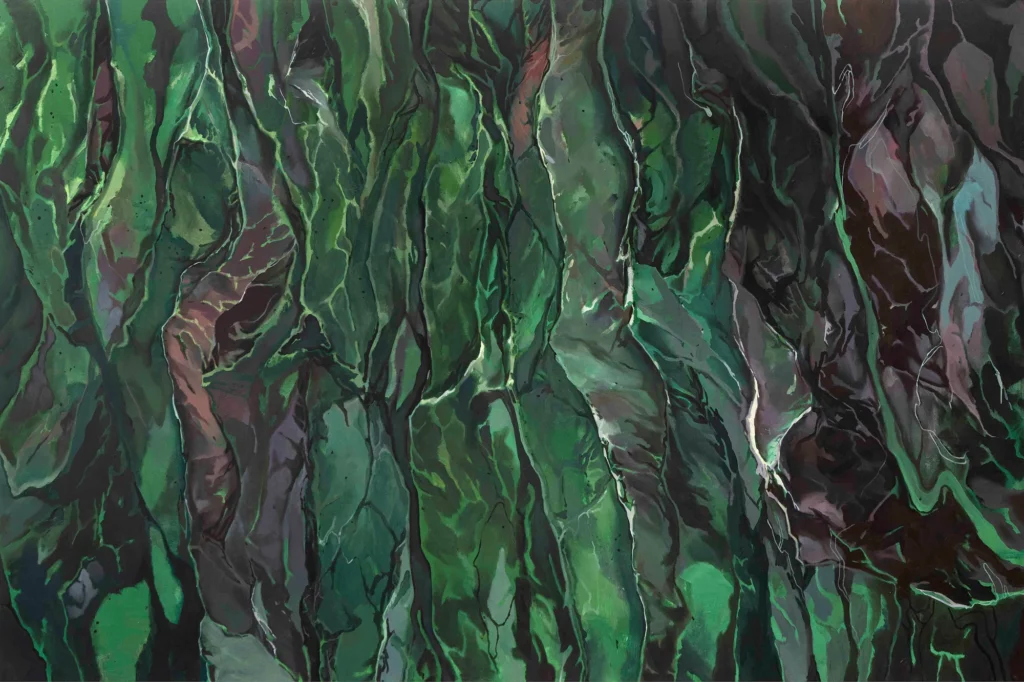
The Lithosphere project is part of a broader exploration of contemporary ways of observing the landscape, directly echoing global visualization platforms such as Google Earth, while engaging with the critical issues of the Anthropocene. Through these paintings, the aim is not to depict a recognizable landscape, but to explore how it is perceived, portrayed in the media, and transformed by digital technologies today.
The compositions explore an aesthetic of aerial perspective and shifts in scale. As in cartographic navigation, the gaze oscillates between a macroscopic view and immersion in the pictorial material. This dynamic produces a perceptual instability: what might appear to be a satellite view gradually dissolves into a dense, textured painted surface where points of reference become blurred. The painting does not seek to imitate the digital image, but rather to absorb its underlying principles—fragmentation, compression, discontinuity—and translate them into a material language.
In this context, the pictorial surface functions as a critical interface. It evokes the layers of images derived from satellites, while introducing alterations: blurring, shifts, areas of saturation, or erasure. Where digital imagery claims to offer immediate legibility and a constantly updated view of reality, *Lithosphère* counters this with a slow temporality, composed of accumulations and transformations. The landscape thus becomes an unstable memory, a reconstructed territory, both shaped by and resistant to technology.
This tension leads directly to the question of the durability of painting. In the Anthropocene era, where images circulate instantly and in dematerialized form, the practice of painting asserts a physical presence, a persistence. It embeds within the material a form of resistance to the rapid obsolescence of digital flows. The layers of paint—their thicknesses and their alterations—evoke a temporality akin to that of geology, echoing the profound transformations of the lithosphere itself. Thus, painting does not merely represent a changing world: it shares in its processes of sedimentation, erosion, and recomposition.
In this sense, *Lithosphère* can be viewed as a sensitive cartography of the Anthropocene. The project creates a tension between two regimes of images: the immaterial and unstable regime of digital tools, and the durable and embodied regime of painting. This confrontation does not produce an opposition, but rather a hybrid space where the conditions of the landscape’s visibility are redefined. The landscape emerges as a field of forces, traversed by flows of information, human traces, and natural dynamics.
Ultimately, painting becomes here a point of convergence between technology and matter, between immediacy and duration. It questions not only the way we see the world, but also our ability to preserve a trace of it. In a context where images multiply and constantly replace one another, *Lithosphère* affirms the need for the long term, for a lasting imprint, making each work a form of resistance against disappearance and oblivion.
Said Afifi
Saïd Afifi is a contemporary artist whose painting practice is rooted in a reflection on landscape, viewed as a space for mental projection as much as a physical reality. For more than fifteen years, he has been developing work focused on the transformation of territories and how they are perceived in the age of digital technology.
His work explores the relationships between observation, memory, and reconstruction. Through his paintings, he explores how contemporary tools—particularly mapping and satellite imaging technologies—influence the way we view the world. His compositions, often structured in layers and fragments, evoke unstable aerial views, where geographical landmarks dissolve in favor of a sensory and subjective interpretation.
In his work, the landscape is never fixed: it appears as a territory in flux, shaped by dynamics similar to those described by the concept of the Anthropocene. His paintings thus reflect the tensions between technological precision and perceptual uncertainty, between a legible surface and material depth.
Saïd Afifi has presented his work in various exhibitions and is part of an artistic movement that questions both the conditions of representation and contemporary issues related to the image and the environment. Her project *Lithosphère* represents a significant milestone in this research, combining a reflection on digital cartography with a sensitive approach to painting as both material and memory.